For a small or midsize manufacturer, AI-driven manufacturing equipment is not a single machine that can be switched on to create a smart factory. It is a connected stack: machines and controls, useful signals, a network, data context, decision support and people who can act. The sensible starting point is a bounded problem, not a promise of full autonomy. An SME can learn more from one governed pilot than from a large installation that produces data nobody trusts.
What AI-Driven Manufacturing Equipment Means for SMEs
AI-Driven Manufacturing Equipment Is a Stack, Not a Single Machine
A CNC cell, for example, depends on more than the cutting machine. A control unit, servo and spindle drives, PLC or PMC logic, I/O, measurement and feedback, external axes and a network all influence what the equipment can report and how it can respond. AI sits above that foundation as a way to detect patterns, organize information or support a decision. It does not repair missing signals or unclear ownership.
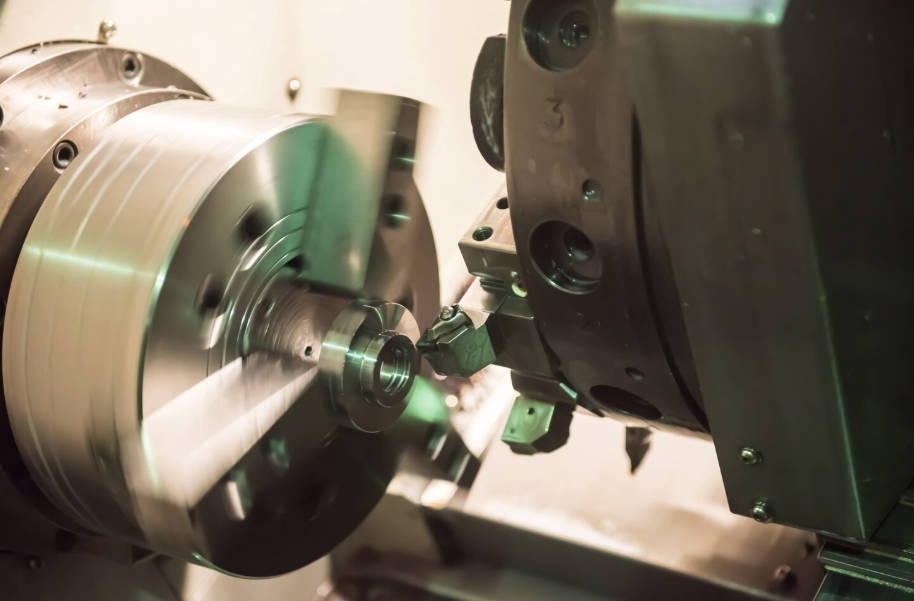
This layered view changes procurement. The buyer should ask how a proposed system identifies the machine, job, material, program, alarm and operator action connected to each record. Without that context, a model may find a correlation that cannot be checked on the shop floor. The equipment becomes useful when the stack and workflow are treated as one system.
Define the SME Baseline for AI Manufacturing Equipment Readiness
Before buying more automation, an SME should record the current state of the process it wants to improve. Useful baseline fields can include unplanned stops, changeover time, scrap observations, inspection steps, operator workload, maintenance actions and the data already available. The purpose is not to invent a target percentage. It is to make the starting condition visible enough for a pilot decision.
The first problem should be specific and repeatable. A team may choose one recurring interruption, one inspection question or one machine state that is difficult to see. An owner should define useful evidence and the manual action. This prevents an equipment purchase from being separated from the decision it should improve.
Pilot AI-Driven Manufacturing Equipment on One Process First
Choose a Bounded Equipment Cell and Decision Use Case
A first pilot should have a limited machine scope, a clear operating owner and a decision that can be validated by people who know the process. Candidate cells can be compared by repeatability, signal availability, operational consequence and ease of intervention. The pilot might support a status review, an anomaly investigation or a maintenance conversation; it should not be described as autonomous control unless that control has been specifically engineered and accepted.
Write the use case in operational language. Identify the event, its context, the reviewer and the following action. Record false alarms and missed signals as learning, not proof of universal model capability. A bounded use case gives AI-driven manufacturing equipment a measurable place in the workflow.
Connect PLC, HMI and IIoT Data for AI Manufacturing Equipment
The connection stage should begin with a signal map. It can show which values come from the machine or PLC, which status is visible in the HMI, which sensors or gateway provide additional context and where records are stored. An industrial gateway can connect CNC information to a remote management layer for status monitoring, fault information, diagnosis and selected updates, but the integration still needs permissions, ownership and a fallback procedure.
Operators should know what the new data view changes. A useful alert has machine identity, job context, timestamp and a documented next step. If a connection fails, the manual path must remain clear. This is how an SME introduces AI-driven manufacturing equipment without making a cell dependent on an opaque data link.
Scale from Pilot Data to a Practical Smart Factory
Scale AI Manufacturing Equipment with Remote Monitoring and Diagnostics
After a pilot, the next step is not automatically a factory-wide model. The team can first decide whether the same data definitions, ownership and review method apply to another cell. Remote monitoring becomes more useful when status, alarms, process information and maintenance records retain time, machine and job context. That context lets an engineer investigate an event instead of receiving an isolated number.
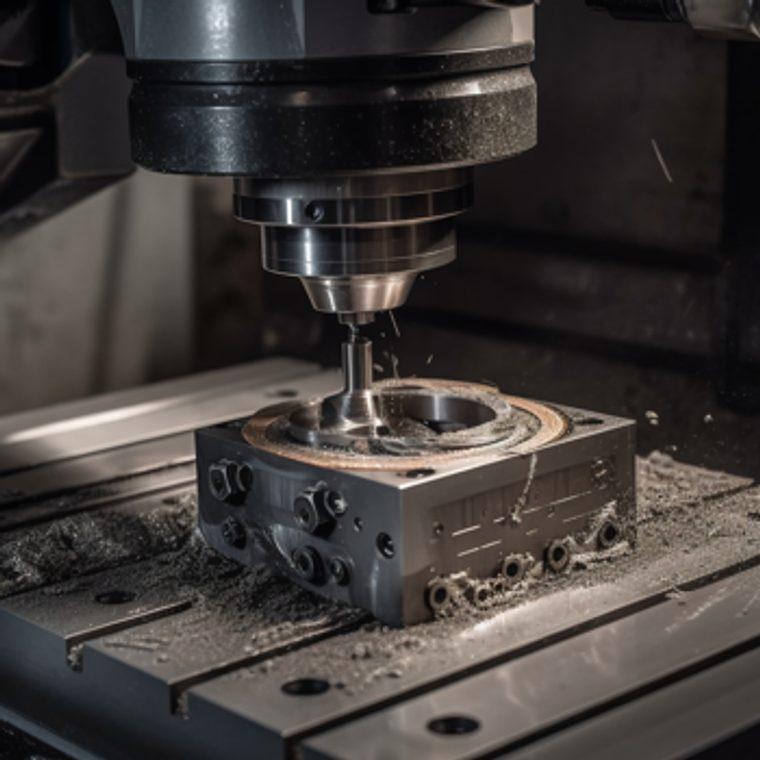
Expansion should preserve human response. A dashboard may show an abnormal state, but an operator or engineer confirms the cause and chooses the intervention. The organization can compare observations, revise the signal map and decide whether a new use case needs validation. This keeps AI-driven manufacturing equipment connected to learning rather than a one-time demonstration.
Standardize AI Manufacturing Equipment Integration, Security and Ownership
Scaling requires rules for access, data retention, model or rule changes, manual override, training and escalation. SMEs should document who can change a connection, who can approve a new decision rule and who is responsible when the system is unavailable. Cybersecurity should be assessed with the plant's IT and controls specialists; a generic AI label is not proof of a secure deployment.
Human ownership applies to model outputs. A recommendation can prioritize an investigation, but the responsible team decides whether to stop a machine, replace a tool or change a process. Standardized records support comparison and reduce incompatible interpretations of AI-driven manufacturing equipment data.
How Momaking Supports SME Equipment and Manufacturing Decisions
Use Industrial Design, CNC and 3D Printing to Validate AI Manufacturing Equipment Parts
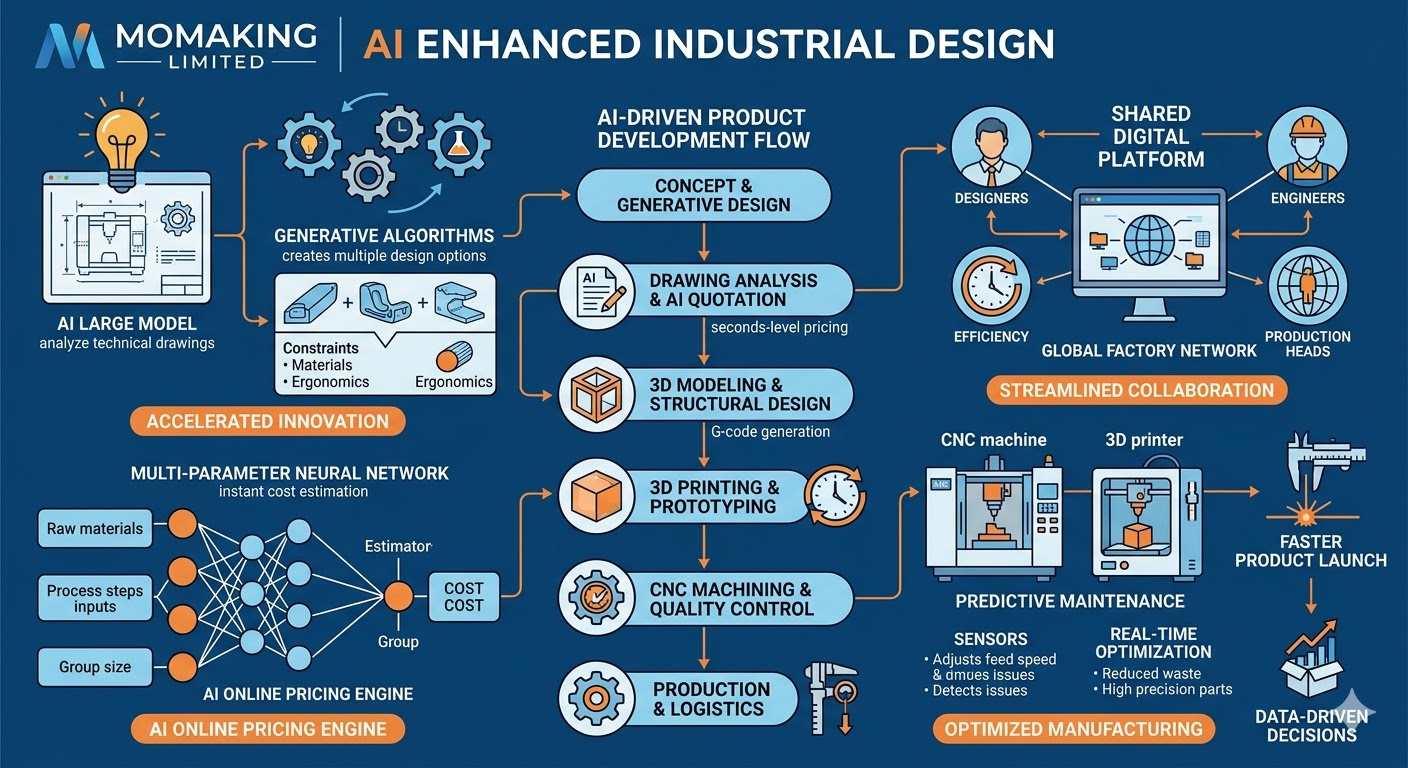
At Momaking, we can support part-side questions next to an equipment project. Our verified scope includes industrial design, structural review, 3D printing and CNC machining. These steps can help an SME examine geometry, interfaces, materials and prototype evidence before deciding how a component or fixture should be produced. The purpose is to clarify the requirement, not to claim a complete smart-factory control system.
For a new part, a reviewed concept can expose an assembly issue or a manufacturing constraint before the equipment plan becomes fixed. A prototype also gives operators and engineers something physical to inspect. The customer remains responsible for plant controls, data architecture, safety procedures and the acceptance criteria for the equipment program.
Turn an AI Manufacturing Equipment Pilot Requirement into a Staged Manufacturing Scope
Our manufacturing categories can be discussed as possible routes after the requirement is clear. Depending on geometry, material, quantity and validation needs, a team may consider 3D printing, CNC machining, mold manufacturing or injection molding. Separating immediate prototype work from later tooling or repeat production keeps the pilot decision understandable and prevents a production assumption from being hidden inside a technology brief.
The role is to connect design intent, prototype evidence and manufacturing discussion. This support does not replace the SME's controls integrator, IT security review, equipment supplier or plant owner. The implementation team must confirm interfaces, permissions, inspection, maintenance and release criteria before expanding the equipment program beyond the pilot.
FAQ
Q: Does an SME need fully autonomous AI manufacturing equipment to start?
A: No. A bounded pilot on one process is a more defensible starting point. The team can validate one decision, its data context, the human response and the operating impact before considering a wider smart-factory program.
Q: Which data should an AI manufacturing equipment pilot collect?
A: Collect the machine state, alarms, job or program identity, relevant process context, quality observations and maintenance actions that help explain the chosen decision. The exact signals depend on the equipment and use case; more data is not automatically better data.
Q: Can Momaking supply a complete smart-factory equipment system?
A: Within the verified scope, Momaking can discuss industrial design, structural review, 3D printing, CNC machining, mold manufacturing and injection molding. A complete factory deployment also requires appropriate controls, connectivity, IT security and plant-integration specialists.